The short answer
Saxenda® is liraglutide, a once-daily injection approved for weight management in adults and in children aged 12 and older with obesity. Its label says to inject it at any time of day, without regard to meals. Small meals that start with protein, steady fluids and strength training help you eat well on it.
On this page
This page is about food and your daily routine. Your dose, and whether Saxenda is right for you, are questions for your prescriber.
What Saxenda is approved for
Saxenda is liraglutide, a GLP-1 receptor agonist made by Novo Nordisk. Its FDA label lists one use: losing excess weight and keeping it off long term, together with changes to what you eat and more physical activity. It covers:
- Adults with obesity
- Adults with overweight and at least one weight-related health condition
- Children aged 12 to 17 with a body weight above 60 kg (132 pounds) and obesity
The Medication Guide says it is not known if Saxenda is safe and effective in children under 12, or in children aged 12 to 17 with type 2 diabetes. The label also says Saxenda should not be used together with other liraglutide products or with any other GLP-1 medicine. Liraglutide is also sold as Victoza®, a separate product for type 2 diabetes with its own label; the liraglutide overview compares the two.
Your daily pen routine
Saxenda comes in a prefilled pen for one person only. You inject it under the skin once a day. The label says your prescriber or pharmacist should train you on the pen before your first dose. A few habits from the Medication Guide and Instructions for Use keep the routine simple:
- Any time of day. The label says to inject it once daily at any time of day, without regard to the timing of meals. Pick a time you will remember, such as after brushing your teeth in the morning.
- Three places. The stomach area, the thigh or the upper arm. Change the spot with each injection. The label says no dose change is needed when you change the site or the time.
- A new needle each time. Pen needles are not included, so keep a supply at home.
- Never share a pen, even with a new needle, because of the risk of infection.
- Carry a spare. The Instructions for Use suggest an extra pen and new needles in case of loss or damage, and say not to leave the pen in a car or anywhere too hot or too cold.
Saxenda starts low and steps up over the first weeks. The steps as the label states them, with its own words on missed doses, are on the liraglutide dose schedule. Always follow your prescriber and your pharmacy label for your own dose.
Storing your pens
Keep new, unused pens in the fridge, at 36°F to 46°F (2°C to 8°C), and never freeze them. The pen you are using can stay at room temperature, 59°F to 86°F (15°C to 30°C), or in the fridge, for 30 days. After 30 days it is thrown away, even if some medicine is left. Store it with the cap on and no needle attached.
What the label says about food and timing
The Medication Guide says Saxenda may be taken with or without food. There is no meal to plan around the injection and no fasting before it.
The label also says Saxenda slows how fast food leaves your stomach. That is one reason a small meal tends to sit better than a large one.
The full meal-by-meal guide is in what to eat on liraglutide.
The first weeks: digestive side effects
The most common side effects in adults, according to the Medication Guide, start with nausea, diarrhea, constipation and vomiting, and include upset stomach and stomach pain. The label says the dose is stepped up slowly at the start to reduce the risk of these stomach side effects.
A 2025 joint advisory from four US nutrition and obesity medicine societies, written for GLP-1 medicines as a group, suggests habits that help:
- Small meals every 3 to 4 hours, rather than one or two large ones
- The protein part of each meal first, before you feel full
- Fewer large or fatty meals, which it links to nausea and diarrhea
- Fluids sipped between meals through the day
- Fiber from food added gradually, if constipation is the problem
On queasy days, soft and cool foods are often easier. These portions from our food list are small:
| Food | Portion | Protein |
|---|---|---|
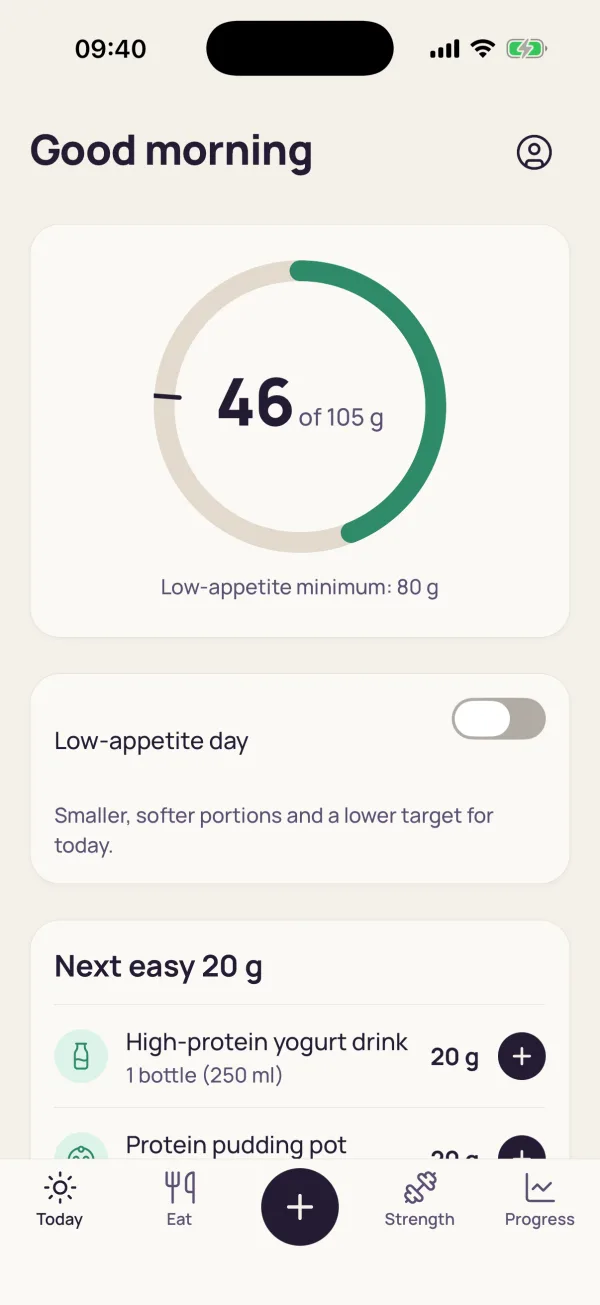
| High-protein yogurt drink | 1 bottle (250 ml) | 20 g |
| Protein pudding pot | 1 pot (200 g) | 20 g |
| Ricotta, part-skim | 124 g (1/2 cup) | 14 g |
| Egg whites, liquid, cooked | 120 ml (1/2 cup) | 13 g |
| White fish (cod, haddock), cooked | 85 g (3 oz) | 19 g |
| Kefir, plain | 240 ml (1 cup) | 9 g |
| Lentil soup | 240 ml (1 cup) | 9 g |
| Tofu, silken | 150 g | 8 g |
Typical values; packaged foods vary by brand. More ideas are in foods for a nausea day and the low-appetite day plan.
If your teenager uses Saxenda
The food habits are the same for a 12 to 17 year old: regular small meals, protein first, fluids. The Medication Guide adds fever and gastroenteritis (a stomach bug) as common side effects in children. It also says children aged 12 and older without type 2 diabetes have a higher risk of low blood sugar on Saxenda, so the advice to avoid long gaps without food matters here too. Ask the prescriber which signs to watch for and what to do.
For activity, the World Health Organization recommends an average of 60 minutes a day of moderate to vigorous activity for children and teenagers, with muscle and bone strengthening activities on at least 3 days a week.
Protein and strength
When you lose weight, some of it is lean mass, which includes muscle. The advisory says more protein alone is likely not enough to keep muscle, and recommends strength training at least 3 times a week, plus at least 150 minutes a week of moderate activity such as brisk walking. The World Health Organization recommends muscle-strengthening activity on at least 2 days a week for all adults.
For protein, the advisory notes that 1.2 to 1.6 g per kilogram of body weight a day has been proposed during weight loss, or a simpler 80 to 120 g a day. The protein calculator gives you a number, and protein per meal shows how to split it across small meals. For training at home, start with the 4-week home plan. If you have kidney disease, ask your doctor before raising your protein.
Other medicines and appointments
Tell your prescriber if you take diabetes medicines, especially insulin or a sulfonylurea; the Medication Guide says the risk of low blood sugar is higher in adults with type 2 diabetes who take them. Because Saxenda slows the stomach, keep a list of everything you take by mouth and show it to your prescriber and pharmacist.
The Medication Guide says Saxenda can raise your heart rate at rest, and that your healthcare provider should check it. Before any surgery or procedure with anesthesia or deep sedation, tell every healthcare provider that you take Saxenda.
When to call your doctor
The Medication Guide says diarrhea, nausea and vomiting can cause a loss of fluids (dehydration), which may cause kidney problems, and that it is important to drink fluids. The water intake calculator gives a daily amount to aim for. Contact your healthcare provider:
- Right away, about nausea, vomiting or diarrhea that does not go away
- About stomach problems that are severe or will not go away
- Right away, about severe stomach pain that will not go away, with or without nausea or vomiting, sometimes felt in your back
- About pain in your upper stomach, fever, yellow skin or eyes, or clay-colored stools (signs of gallbladder problems)
- About a lump or swelling in your neck, hoarseness, trouble swallowing or shortness of breath
- About your heart racing or pounding for several minutes
Get medical help right away for signs of a serious allergic reaction, such as swelling of the face, lips, tongue or throat, or trouble breathing or swallowing.
If you can't keep food or fluids down, or a symptom is severe or doesn't go away, contact your doctor.
Questions
How long does a Saxenda pen last once I start it?
The Medication Guide says the pen you are using should be thrown away after 30 days, even if it still has some medicine left in it. Write the start date on a note or in your phone so you know when to change it.
Does Saxenda need to be kept in the fridge?
New, unused pens go in the fridge, at 36°F to 46°F (2°C to 8°C). The pen you are using can be kept for 30 days at room temperature, 59°F to 86°F (15°C to 30°C), or in the fridge. Never freeze it, and don't use a pen that has been frozen.
Can I change where I inject Saxenda?
Yes. The Medication Guide says to change (rotate) your injection site with each injection, and the label says no dose change is needed when you change the site or the time. Use the stomach area, thigh or upper arm.
What if I miss a Saxenda dose?
The Medication Guide says to take your next daily dose as usual the following day, and not to take an extra dose to make up for it. If you miss 3 days or more, call your healthcare provider to talk about how to restart. The label's own words are on our liraglutide dose schedule.
Can Saxenda make my heart beat faster?
The Medication Guide says Saxenda can increase your heart rate while you are at rest, and that your healthcare provider should check it. Tell your provider if you feel your heart racing or pounding in your chest and it lasts for several minutes.
Can Saxenda cause low blood sugar if I don't have diabetes?
The Medication Guide lists a higher risk of low blood sugar in adults with type 2 diabetes, especially with insulin or a sulfonylurea, and in children aged 12 and older without type 2 diabetes. Ask your healthcare provider how to recognize and treat it.
Does Saxenda affect other medicines I take by mouth?
The label says Saxenda slows how fast the stomach empties, which may affect how medicines taken by mouth are absorbed. Keep a list of everything you take, including vitamins and supplements, and show it to your prescriber and pharmacist.
Why you can trust this guide
- Every fact links to a source we opened and read, listed below.
- Updated 23 November 2026. When guidance changes, we check the guides that rely on it.
- Food and training only. Your dose and medication are for your prescriber.
Sources
- Saxenda® (liraglutide) prescribing information, Medication Guide and Instructions for Use (DailyMed), Novo Nordisk, U.S. National Library of Medicine, 2026. Checked 23 November 2026.
- Nutritional priorities to support GLP-1 therapy for obesity: a joint advisory (Mozaffarian et al.), American Journal of Clinical Nutrition, 2025. Checked 23 November 2026.
- World Health Organization 2020 guidelines on physical activity and sedentary behaviour (Bull et al.), British Journal of Sports Medicine, 2020. Checked 23 November 2026.